
Preamble
For decades, Ghana has been hailed as the star pupil of West Africa, thus, a beacon of democracy and stability. Yet, today, many Ghanaians are asking tough questions firstly, on why, with all our gold, cocoa, and oil among relatable others, we are still trapped in a cycle of debt, currency depreciation, and imported hardship. Again, why does a bag of rice, a tomato, or a cement block often carry the weight of a weakening cedi and distant supply chains?
Looking to the border north, we see a nation once written off, a desert and jihadist invaded economy, Burkina Faso making historic waves globally especially in the West African region. Under the leadership of Captain Ibrahim Traoré, a dramatic, unorthodox, and fiercely nationalistic economic experiment is unfolding in spite of its military regime and or governance.
The Traore Model Explored
The Captain Ibrahim Traoré Model (CITM), a model born not in an IMF or World Bank boardroom, but in the dust of the Sahel and the fires of popular frustration boldly sets on to reject the old playbook or the old narrative of France dictatorship and rulership amidst Western dominance in a bid to attaining results that are making the world, and perhaps Ghana, take notice.
So we question, is this the radical cue Ghana needs? A blueprint for economic sovereignty? Or a perilous path?
On the 8th of January, the trailblazing media goddess and host of Anopa Bosua, Mrs. Victoria Beeko-Danso of Amansan TV sat with Dr. Lucy Anning to dissect the Captain Ibrahim Traoré Model, its startling projects, its hard numbers (factual statistical figures), and the pressing question on what can, and should, Ghana learn from its neighbour’s revolutionary gamble.
Core Strategy of The Traoré Model: Decolonizing Burkina Faso’s Economy, Brick By Brick
The core philosophy to the model is “Production First, Consumption Later.\” The model is built on a foundation of radical economic sovereignty, positing that true development cannot be financed by eternal debt, nor can food security be outsourced. It is a direct, state-driven mobilization of national resources for national needs.
The Traoré Model: Burkina Faso’s Three-Pillar Revolt against Dependency
At the heart of Captain Ibrahim Traoré’s political project lies a deceptively simple question: Who benefits? Who benefits from Burkina Faso’s land, gold, and labor? For decades, the answer was rarely the Burkinabé people. The CITM—often visualized as a triangle—seeks to flip that equation through three mutually reinforcing pillars including Food Sovereignty, Resource Nationalism, and Sovereign Infrastructure, all bound together by popular mobilization and anti-corruption rhetoric.
This is not ideology for ideology’s sake but a governing method geared towards direct, muscular, and intentionally disruptive.
Pillar One: Food Sovereignty – Feeding the Nation to Rule It Utilizing Prison Labour
On the nugget of “He who does not feed you, does not deserve to rule you.” Traoré reframed legitimacy itself. Before 2022, Burkina Faso spent over $400 million annually importing basic foodstuffs—onions from Europe, tomatoes from neighboring states—while fertile land lay underused.
The response was blunt force economics with Import bans on onions, potatoes, maize, and soon rice erected a protected domestic market overnight. The result was seen in a surge in local production, with onion output reportedly jumping over 60% in a single year. Farmers finally had guaranteed buyers, predictable prices, and state backing.
At the center sits Bagrépôle, a 30,000-hectare agro-industrial cluster powered by the Bagré Dam. This is not peasant romanticism—it is industrial agriculture with processing, packaging, and logistics integrated end-to-end. Mechanization drives, fueled by thousands of tractors sourced through non-Western partnerships, signal a clear shift: food is no longer charity—it is strategy.
Pillar Two: Resource Nationalism – Ending Structural Looting
Gold is Burkina Faso’s crown jewel, generating $5–6 billion annually, yet for years the state captured little more than scraps. Traoré calls this arrangement what it was: structural looting.
Under the new model, mining contracts are being renegotiated aggressively, pushing the state’s equity stake from 10–20% toward 30–50%. But ownership is only the first step while value capture is the real prize.
Entering the Ouagadougou gold refinery, revived with Russian partnership, the goal is to refine at least half of national production locally by 2025, keeping value, jobs, and expertise inside the country. Alongside this are new partnerships with Russia, Turkey, and Iran—framed not as ideological alignment, but as pragmatic deals free from IMF and World Bank conditionalities. Resources are exchanged not for lectures, but for infrastructure and security.
Pillar Three: Sovereign Infrastructure – Development as a Battlefield
In Traoré’s Burkina Faso, development is conducted with wartime urgency. The army’s engineering corps has become a national construction firm, building roads, dams, hospitals, and silos.
The flagship 350km East-West Strategic Road links farms and mines directly to markets—built by military engineers and local firms, deliberately bypassing costly international contractors. Alongside it are 100+ “People’s Projects”, fast-tracked and financed through redirected mining revenues, barter arrangements, and public patriotism.
This is the Sankofa spirit without nostalgia: reclaiming self-reliance to move forward, not backward.
The Center Holds: Popular Mobilization and Anti-Corruption
Holding the triangle together is a relentless anti-corruption narrative. Traoré positions waste and elite capture as enemies as dangerous as insurgents. The message is clear, repeatable, and effective: sacrifice is shared, and the state is finally on the people’s side.
The Traoré Model is risky, unfinished, and deeply contested but coherent. It feeds the people, reclaims the gold beneath their feet, and builds with their own hands. Below is a graphical representation of the CITM.
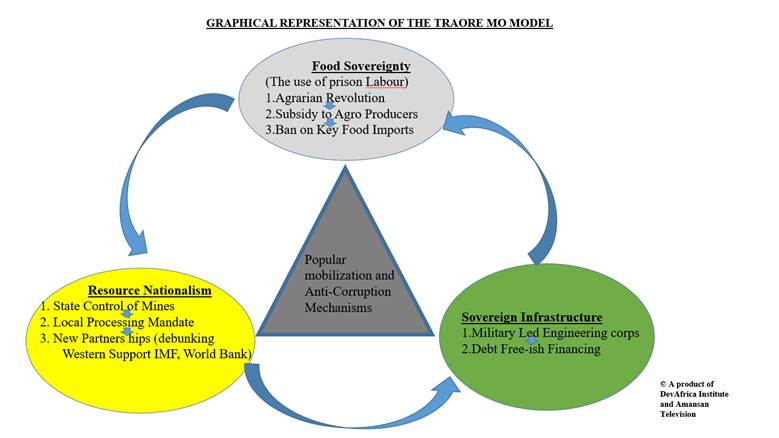
Source: Authors Construct, 2026
LESSONS OR CUES FOR GHANA
GHANA AT THE CROSSROADS: SANKOFA OR STAGNATION?
Ghana’s context is different given the fact that Ghana has a mature democracy, deeper global financial integration, and a larger, more complex economy. To this effect, a direct copy is impossible and unwise, however the principles are a stark mirror.
Lesson 1: From Agri-Policy to Agri-War.
Ghana spends over $1 billion annually on food imports (rice, poultry, tomatoes etc). Our flagship \”Planting for Food and Jobs\” has had mixed results, plagued by input subsidy corruption and competition from cheap imports.
· Ghana’s Adoption Cue stems in declaring a \”Strategic Staple Food Shield\” with an Imposed phased, strategic tariffs on rice and poultry, through a 5-year sunset clause. Channel every cedi of those tariffs into a Ghana Agro-Industrial Transformation Authority (GAITA) – a military-precision agency to develop irrigation systems, mechanization hubs, and guaranteed offtake agreements. The target is to cut food import bill by 40% in 4 years.
Imagine: The Afram Plains and Northern Regions as Ghana’s undisputed breadbasket.
Lesson 2: Resource Patriotism – Beyond Royalties.
Ghana has mined gold for 150 years. We are Africa’s largest producer. Yet, where is our sovereign? We export raw lithium in a green mineral rush, with a mere 10% royalty and 13% state carry.
· Ghana’s Adoption Cue: Renegotiate, Avoiding Mere Regulation.
There is a need to launch an \”Operation Value Capture\” across all mining and nascent lithium/oil contracts. Mandate a minimum 30% state participation in all new concessions. Fast-track the gold refinery with strategic, not just commercial, partners.
Strict Law Enforcement: No raw lithium leaves Ghanaian shores after 2027. The core agenda is to move from being a pit to a platform for battery manufacturing.
Lesson 3: The Infrastructure Mobilization Mindset.
Ghana’s debt, exceeding ₵600 billion, is a millstone around every infrastructure project. We debate, tender, borrow, and stall.
· Ghana’s Adoption Cue: Create a National Strategic Infrastructure Corps (NSIC) to mobilize the talents of the Ghana Armed Forces Engineering Regiment, the GRATIS Foundation, and local contractors for a debt-light, high-impact project list.
Also, Revive the Eastern Railway not with a $5bn Chinese loan, but with a hybrid model: part barter (using cocoa, gold), part dedicated mineral royalties, part sweat equity. Restore the Tema Oil Refinery to full capacity not by waiting for a foreign investor, but by treating it as a national security asset.
Essentially, Burkina’s model is bankrolled by a security crisis that justifies any measure. Their partnerships with Moscow are geopolitically toxic. Import bans can cause inflation. State-led projects are historically corruptible. Ghana’s strength is its open, democratic, rules-based system. We need reform, not revolution.\”
Anchor’s Fusion:
The numbers don’t lie. Burkina is making painful, risky choices for a perceived long-term gain while Ghana is making painful, familiar choices for short-term relief. The question for Ghana is about agency. Can we find a democratic, Ghanaian way to harness this spirit of sovereign urgency? Can we be as bold in our economic thinking as we have been in our democratic journey?\”
CONCLUDING REMARK
In closing the intense discussion, one fact stood out, Burkina Faso, under Captain Traoré, is playing a dangerous but decisive game of economic poker. They have looked at their cards—land, gold, and a defiant population—and gone all in.
Ghana adversely, holds a much stronger hand consisting of peace, democracy, cocoa, gold, oil, lithium, and a dynamic people, yet for far too long, we have played our hand by someone else’s rulebook, cautiously, afraid to upset the table. The result has been that we win small pots but keep losing the grand prize—our own prosperity.
The cue from Ouagadougou is not to become Burkina Faso. It is to finally, unapologetically, play the Ghana Game. To write our own rules. To build our own table. To bet on ourselves. The alternative is not stability; it is a slow, respectable decline. The world is watching. The moment, as they say in the markets, is now. Will Ghana call, raise, or fold?
For full video, please click on the link below;
A Product of DevAfrica Institute and Amansan TV